Category: History

  • History of Cordoba

    History of Cordoba

    Córdoba is a historic city in southern Spain, known for its rich cultural heritage and stunning architecture. Influenced by Roman, Islamic, and Christian civilizations, it offers a unique blend of history, tradition, and beauty that can be seen in its streets, monuments, and vibrant atmosphere.

    Interactive timeline

    History of Córdoba, Spain

    Explore the main historical periods that shaped Córdoba, from Roman times to the present day. Use the filters to focus on a specific era and open each card to read more.

    169 BC
    Ancient period

    Roman Córdoba

    Córdoba became an important Roman settlement and later a major city of Hispania, known as Corduba.

    Under Roman rule, Córdoba developed political, commercial, and cultural importance. It was also connected to the wider Roman world through roads, bridges, and urban infrastructure.
    1st century BC
    Ancient period

    Birthplace of Seneca

    The philosopher Seneca, one of the most famous intellectual figures of Roman Spain, was born in Córdoba.

    Seneca became one of the best-known Stoic philosophers of the Roman Empire. His connection with Córdoba reflects the city’s importance during the Roman period.
    711 AD
    Medieval period

    Islamic rule begins

    After the Muslim conquest of the Iberian Peninsula, Córdoba entered a new period that transformed the city.

    This marked the start of al-Andalus in the region. Córdoba gradually became one of the most influential urban centres in Europe during the medieval period.
    756 AD
    Medieval period

    Capital of the Emirate

    Abd al-Rahman I established the Emirate of Córdoba and made the city its political capital.

    Córdoba gained political stability and prestige. This period also saw the beginning of major architectural and urban growth, including the early construction of the Great Mosque.
    929 AD
    Medieval period

    The Caliphate of Córdoba

    Abd al-Rahman III proclaimed the Caliphate, and Córdoba reached its greatest political and cultural power.

    During the Caliphate, Córdoba became famous for scholarship, science, philosophy, trade, and architecture. It was one of the most remarkable cities in medieval Europe.
    10th century
    Medieval period

    Medina Azahara

    The palatial city of Medina Azahara was built near Córdoba as a symbol of caliphal power and splendour.

    The complex included administrative, ceremonial, and residential areas. Today it remains one of the most important archaeological sites connected with Islamic Spain.
    1236 AD
    Medieval period

    Christian conquest

    Córdoba was conquered by Ferdinand III of Castile and became part of the Christian kingdoms.

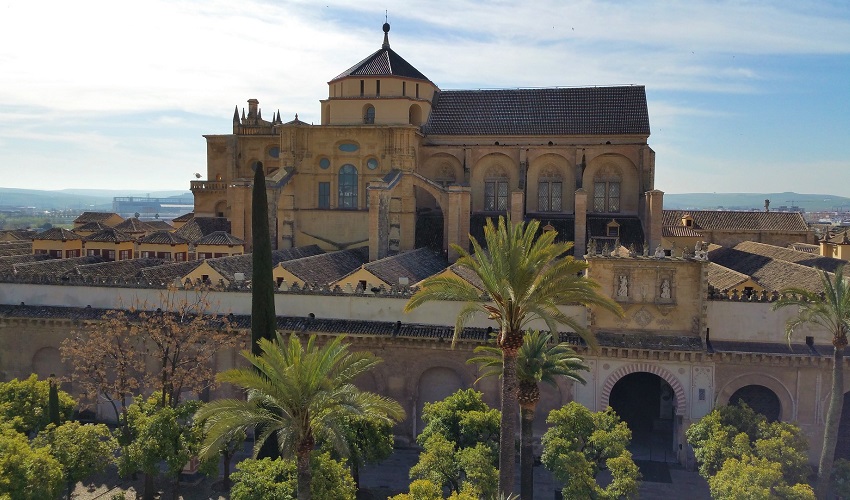
    This event reshaped the city politically and religiously. The Great Mosque was later adapted into the cathedral, creating one of Córdoba’s most iconic monuments.
    16th century
    Modern period

    Cathedral inside the Mosque

    A Renaissance cathedral nave was inserted into the former mosque, creating the Mezquita-Catedral we know today.

    This transformation reflects the layered history of Córdoba, where Roman, Islamic, Jewish, and Christian influences remain visible in the urban landscape.
    1984
    Modern period

    UNESCO recognition

    The historic centre and the Mosque-Cathedral gained international recognition as World Heritage landmarks.

    UNESCO recognition highlighted Córdoba’s exceptional architectural and cultural value and helped reinforce its position as one of Spain’s most important heritage cities.
    Today
    Modern period

    A city of living heritage

    Córdoba continues to be known for its history, patios, gastronomy, and the coexistence of different cultural traditions.
    The city combines tourism, daily life, and historical identity. Its monuments, festivals, and neighbourhoods make the past visible in the present.

Welcome to Córdoba

Home 

In this website you will discover the best places to visit, traditional restaurants, and interesting facts about the history of this beautiful city.